
bloglovinBloglovin iconCombined ShapeCreated with Sketch. Fill 1Created with Sketch. Fill 1Created with Sketch. Fill 1Created with Sketch. Fill 1Created with Sketch. Fill 1Created with Sketch. rssRSS iconsoundcloudSoundCloud iconFill 1Created with Sketch. Fill 1Created with Sketch. Fill 1Created with Sketch. Fill 1Created with Sketch.
man and woman sitting on chair in front of table with food

A free program

If you’ve felt it, you know magic happens when the right people enter a space.

Sometimes it’s serendipity; most of the time there’s a driving force.

I want to encourage you to take part in what Seth Godin has dubbed the Connection Economy — to use your most meaningful relationships to inspire you to create art, contribute to your community, and nourish the connections in your own life.

Deepen the connections in your world and start conversations that matter.

I’m thrilled by the prospect of sharing my passion and work. The capacity for what can happen when the right people come together is unlimited and largely untapped. Call this six-week program whatever you want: a book club, a group, an experiment, an adventure.

There are people in your world who need to meet.

Your efforts to organize this program may change someone’s life, but it’s up to you to make it happen. There are people out there who are stuck (as you may have discovered, paths are rarely straight and laid out). Be present and challenge each other with kindness and care.

We all have something unique to share. Let’s help each other do the tough work.

Questions? Successes? Let me know how it goes.

Step 1. Form a group.

Sure, you can do this alone. But a group offers support, accountability, and the ability to help you up your game. You want people who can call you out, people who can serve as your cohort and personal network as you advance your ideas forward. Your group is your sounding board, letting you know when you’re on track and gently nudging you when you’re off.

It doesn’t matter how many are in your group; it could be one other person or four. Call up a few friends and send out emails, “Will you try something new with me?”

Step 2. Time and place.

Face time can’t be substituted. Choose one location and meet consistently, each week. Settle on the details and commit. Six weeks. No excuses.

Respect everyone’s time. Everyone is busy. Make each other a priority.

Step 3. Finalize your reading list.

I’ve listed several books for you to use as a starting block. Recommended, but by no means required. If you have a book that has been especially influential to you, use that one instead.

Sample book list:
Linchpin
Poke the Box workbook
Superconnect
Business Model Generation
E Myth Revisited
4 Hour Work Week
Creatively Independent
Make Your Idea Matter
Host an unforgettable dinner party

Step 4: Homework (Projects & Exercises):

The activities suggested are designed to get you out of your comfort zone, inspire you, and reinforce what you’re reading. If you feel inclined to add your own twist, please do.

Most importantly, set aside time to make writing a priority. I’ve listed a few prompts to encourage you and provide creative direction. Again, use what is helpful and improve what isn’t. Not everything will work for everyone.

Week 1

Reading: Bernadette Jiwa’s Make Your Idea MatterSample journal
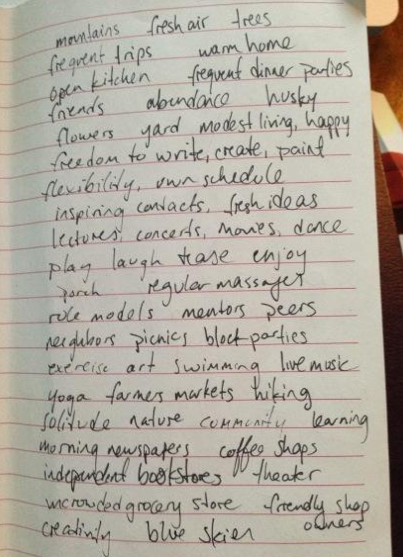
Project: Go find a journal that inspires you. Buy it from that indie book store you’ve always wanted to check out, look for something inspiring while you’re waiting in line, make it yourself.
Writing exercise: Set your alarm for ten minutes. Choose one:

  • Imagine your dream life. Envision everything it entails. Now write. It doesn’t need to be complete sentences or thoughts, words are fine.
  • Ask questions. Write them down, every question you can think of. They don’t need to make sense. You don’t need to have the answers. Tangential is fine. Just ask.

Discuss: What is the difference between dreaming and storytelling? Do you set aside time to create and dream? What stories do you tell yourself? To others?

Week 2

Reading: Tim Ferriss’ 4 Hour Work Week
Project: Do something new this week. Cook dinner with veggies from the local market. Sign up for a class. Explore a new neighborhood. Get lost in a library.
Writing exercise: If you could do anything, anywhere, what would it be?

Discuss: How do you define work/life balance? Is a distinction necessary?

Week 3

Reading: Seth Godin’s Poke the Box workbook
Project: Print out the workbook. Plan thirty minutes of uninterrupted time to complete.
Writing exercise: Notice any areas of hesitation while you’re completing the workbook. Is there a particular topic that seems more challenging than others?

Discuss: What obstacles stop you from shipping? How are you getting in your own way?

Week 4

Reading: Project Exponential’s Host an unforgettable dinner party
Project: Schedule a lunch date or host a dinner party.
Writing exercise: Set your alarm for ten minutes. Choose one:

  • What are the traits you most admire in others?  What are the traits you’re most proud of?
  • Assemble an imaginary Dream Team. You get five players. Who do you choose? What skills do they offer?

Discuss: Talk about how teams are formed and what kind of environments contribute to their growth. What kind of people belong on your Dream Team? Who inspires you?

Week 5

Reading: Jess Pillmores’s Creatively Independent
Project: Challenge yourself to write the first draft of your very own ebook.
Writing exercise: Consider the uniqueness that you, and only you, bring to your work, your relationships, your family. What separates you from competition? What is that one trait that singles you out?

Discuss: How do you stay inspired while working on a big [exhausting] project? What tricks and techniques have you found to be most helpful when setting big goals?

Week 6

ReadingE Myth Revisited and/or Business Model Generation
Project: Brainstorm how you might turn $10 into $100.
Writing exercise: Write out a sample business plan. What would you do if you had no excuses, no responsibilities? Journey back to the days of mowing lawns, selling lemonade, babysitting. What would change if today was your last day at your current job?

Discuss: Would things be different if you consistently set aside time to write, dream, explore, learn?

7 ways to up your game by meeting people

1. Connect with other industries.

Spending time with professionals who excel in industries other than your own can help you discover new approaches in your own line of work. Step outside of your immediate field, identify transferrable skills, and work together on complementary initiatives.

2. Discuss things that aren’t familiar.

Learn new terms and expand your horizons by venturing from typical conversation starters. A learned tidbit may assist you in building rapport with a future business partner.

3. Ask questions.

The right questions can turn a mundane introduction into a lasting impression, and most people are eager to talk about themselves to those willing to listen. Ask open ended questions about thoughtful topics to get the ball rolling.

4. Spend time outside of the office.

Shared experiences in unexpected environments can build relationships in unique ways. People often display varying characteristics depending on the situation; you may need to encounter an individual in many settings before identifying their true character.

5. Get to know their priorities.

An individual’s priorities can be a valuable window into their life. See if you can determine what contributes to their success and drives their work.

6. Unite through humanity.

Be forthright about your challenges. Moments of authenticity and vulnerability can be scary, but they connect us on a much deeper level than superficial pleasantries. Dare to be open; the response might surprise you.

7. Brainstorm.

Use networking opportunities as brainstorming sessions. Explore new ideas. Find news ways to look at old situations. Help each other. Innovate and create together. A stranger can offer a removed perspective to obstacles you regularly encounter.

Get what you want by working backwards

Big Goals — the ones worth mentioning — typically fall into one of two categories:

1. You really, really want something.

Big Goal: I want to … travel around the world, be the company’s top earner, find a fulfilling relationship, double my savings account, change careers.

2. You want to change your behavior.

Big Goal: I am going to … lose weight, eat mindfully, stop smoking, be independent, make confident decisions, become more organized.

Big Goals sound daunting because they’re not easy (if it sounds easy, it probably isn’t a Big Goal). These kinds of goals often entail major life changes — career, relationship, health — and require concentrated focus and energy.

Lately, many of my meetings have involved some sort of goal setting tirade: how to set goals, frustration with achieving them, fear of failing, uncertainty. Since my days working as a probation officer, I’ve encouraged people to set Big Goals, ones that are both lofty and achievable. The trick to success?

Work backwards.

This may sound counterintuitive, but it works.
After you’ve identified and set your Big Goal(s), you must plan smaller, manageable subgoals that point you in the direction of your identified finish line.

Big Goal: I am going to get fit.

subgoal: I am going to start a food diary.

subgoal: I will pack lunch twice this week.

subgoal: I am going to explore different forms of exercise and find what I enjoy.

subgoal: I am going to schedule workouts into my calendar.

etc.

It’s not enough to write your dream on a board and walk away. Your chances of accomplishing Big Goals proportionally increase with the planning and thought you put into your game plan. Subgoals are essential if you’re looking to knock it out of the park.
Set periodic check-in reminders to help you assess whether you are on track. Think of it as a training plan: no marathoner wills himself past the finish line. Successful race days are the result of many mini-runs, planned efforts set with an end result in mind. There’s a reason step-by-step guides work. They take complex processes and break them down into approachable actions.

Big Goal: I am going to get fit. 

today: I am going to start a food diary.

this week: I will pack a lunch twice this week.

by next week: I am going to explore different forms of exercise and find one that I enjoy.

this month: I am going to schedule workouts.

etc.

Set Big Goals. Don’t cut yourself slack.
Just increase your betting odds by making a plan to get there.
 

20 questions to ask as you enter a new year

They work best if you’re honest:

  1. Am I holding onto any beliefs that aren’t serving me?
  2. What do I want to learn this year?
  3. Have I set any long-term goals?
  4. Are my daily decisions setting me up for success?
  5. Do my present priorities accurately reflect my innermost dreams and desires?
  6. Is my work fulfilling my creative desires?
  7. Am I creating time to pursue outside interests?
  8. Do I regularly allow myself to dream?
  9. Is there a specific topic I can learn more about that will help advance my career?
  10. Have I surrounded myself with people who can help me achieve my goals (and encourage me to get there)?
  11. Are my personal relationships fulfilling?
  12. How do I want to be introduced when meeting strangers?
  13. Do I take an active interest in my health?
  14. How can I regularly create a supportive, positive environment for myself?
  15. What lessons have I learned from past failures and mistakes?
  16. What decisions have I made that that support my belief in my own aptitude?
  17. Do I believe that I have art/work/products that will benefit the world?
  18. Am I becoming more of the person I hope to be?
  19. What is preventing me from change?
  20. How can I start today?

36 lessons from NYC

In no particular order:

  1. You can walk as fast as you want, but you won’t get anywhere without considering those around you.
  2. On your worst days, something (or someone) will surprise you and show you kindness in ways you’d never expect.
  3. On your best days, something (or someone) will knock you down, humble you, and disappoint you in ways you’d never expect.
  4. There’s always someone better than you.
  5. There’s always someone with less than you.
  6. Find something to be grateful for every day.
  7. A smile can disarm anyone.
  8. You’ll only be happy if you’re true to yourself.
  9. You are defined by the company you keep.
  10. You have the ability to reinvent yourself. Every day.
  11. Most of the limits you see are created in your own mind. Sprint past them when possible and refuse to get in your own way.
  12. Relationships take work.
  13. There is someone for everyone.
  14. Everyone is beautiful in their own way. Look for this beauty in everyone you meet.
  15. Set aside time to nurture those who are important to you.
  16. Communities are essential. No matter your interests, there is one for you.
  17. Learn how to set boundaries and take care of yourself.
  18. Prioritize.
  19. You can view each day as a battlefield or a marvelous adventure. Your choice.
  20. There is always more money to be earned. Learn to be content with what you have.
  21. You probably have more than you need.
  22. You will be tested. Eventually, you will realize you are capable of much more than you think.
  23. Grocery stores don’t need to accommodate small cars. People get along just fine with handbaskets.
  24. It doesn’t matter what it looks like or how many square feet, home is where the heart is.
  25. Movie stars are people, too.
  26. You can put your body through some really grueling activities. It’s capable of amazing things. Be kind to it. You only get one.
  27. Get a bike. And get a damn good lock. If you don’t have a good lock, carry your front tire with you.
  28. It doesn’t matter how cute your shoes are, they better be comfortable and durable.
  29. The outdoors are closer than you think. Don’t neglect blue skies and trees.
  30. There is no reason to eat shitty food.
  31. Challenge yourself to find something new and try something new regularly.
  32. Refuse to settle.
  33. There are plenty of jobs. If you don’t like the one you have, life is too short to waste another day.
  34. Be open — to possibilities, different opinions, new ideas, different beliefs, new opportunities. If you are willing, your world will explode with options. Your choice.
  35. Everyone is creative. Express it in your own way.
  36. You really can create the life you want.

your dream job is on your desk

What if someone told you that you missed the boat? That the golden ticket to a beautiful home, a happy heart, and an adventurous life was in your back pocket?

What would happen if your phone rang and your boss declared you an asset to the company? If the grocery store clerk looked straight into your eyes and called you a visionary?

What if you found out that “perfect moment” you’ve been waiting for already happened?

What if…

It’s time to find out.

I’ve designed a new offering — part seminar, mentoring circle, book club, networking accelerator, an experience like no other — to challenge you to think beyond “what if” and start venturing into this is it. The first session begins after the holiday season, so you can launch your dreams and your life in a whole new way in 2013.

Learn more about the why and the what here.