
bloglovinBloglovin iconCombined ShapeCreated with Sketch. Fill 1Created with Sketch. Fill 1Created with Sketch. Fill 1Created with Sketch. Fill 1Created with Sketch. Fill 1Created with Sketch. rssRSS iconsoundcloudSoundCloud iconFill 1Created with Sketch. Fill 1Created with Sketch. Fill 1Created with Sketch. Fill 1Created with Sketch.
man and woman sitting on chair in front of table with food

A free program

If you’ve felt it, you know magic happens when the right people enter a space.

Sometimes it’s serendipity; most of the time there’s a driving force.

I want to encourage you to take part in what Seth Godin has dubbed the Connection Economy — to use your most meaningful relationships to inspire you to create art, contribute to your community, and nourish the connections in your own life.

Deepen the connections in your world and start conversations that matter.

I’m thrilled by the prospect of sharing my passion and work. The capacity for what can happen when the right people come together is unlimited and largely untapped. Call this six-week program whatever you want: a book club, a group, an experiment, an adventure.

There are people in your world who need to meet.

Your efforts to organize this program may change someone’s life, but it’s up to you to make it happen. There are people out there who are stuck (as you may have discovered, paths are rarely straight and laid out). Be present and challenge each other with kindness and care.

We all have something unique to share. Let’s help each other do the tough work.

Questions? Successes? Let me know how it goes.

Step 1. Form a group.

Sure, you can do this alone. But a group offers support, accountability, and the ability to help you up your game. You want people who can call you out, people who can serve as your cohort and personal network as you advance your ideas forward. Your group is your sounding board, letting you know when you’re on track and gently nudging you when you’re off.

It doesn’t matter how many are in your group; it could be one other person or four. Call up a few friends and send out emails, “Will you try something new with me?”

Step 2. Time and place.

Face time can’t be substituted. Choose one location and meet consistently, each week. Settle on the details and commit. Six weeks. No excuses.

Respect everyone’s time. Everyone is busy. Make each other a priority.

Step 3. Finalize your reading list.

I’ve listed several books for you to use as a starting block. Recommended, but by no means required. If you have a book that has been especially influential to you, use that one instead.

Sample book list:
Linchpin
Poke the Box workbook
Superconnect
Business Model Generation
E Myth Revisited
4 Hour Work Week
Creatively Independent
Make Your Idea Matter
Host an unforgettable dinner party

Step 4: Homework (Projects & Exercises):

The activities suggested are designed to get you out of your comfort zone, inspire you, and reinforce what you’re reading. If you feel inclined to add your own twist, please do.

Most importantly, set aside time to make writing a priority. I’ve listed a few prompts to encourage you and provide creative direction. Again, use what is helpful and improve what isn’t. Not everything will work for everyone.

Week 1

Reading: Bernadette Jiwa’s Make Your Idea MatterSample journal
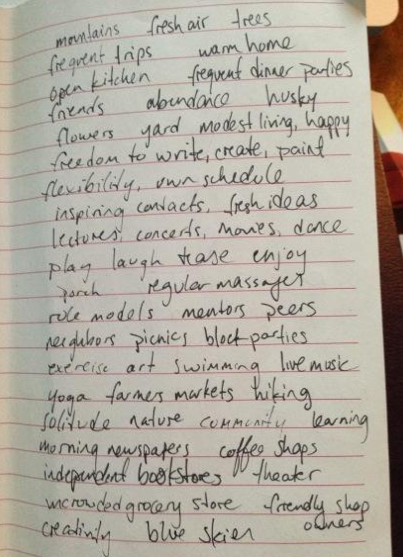
Project: Go find a journal that inspires you. Buy it from that indie book store you’ve always wanted to check out, look for something inspiring while you’re waiting in line, make it yourself.
Writing exercise: Set your alarm for ten minutes. Choose one:

  • Imagine your dream life. Envision everything it entails. Now write. It doesn’t need to be complete sentences or thoughts, words are fine.
  • Ask questions. Write them down, every question you can think of. They don’t need to make sense. You don’t need to have the answers. Tangential is fine. Just ask.

Discuss: What is the difference between dreaming and storytelling? Do you set aside time to create and dream? What stories do you tell yourself? To others?

Week 2

Reading: Tim Ferriss’ 4 Hour Work Week
Project: Do something new this week. Cook dinner with veggies from the local market. Sign up for a class. Explore a new neighborhood. Get lost in a library.
Writing exercise: If you could do anything, anywhere, what would it be?

Discuss: How do you define work/life balance? Is a distinction necessary?

Week 3

Reading: Seth Godin’s Poke the Box workbook
Project: Print out the workbook. Plan thirty minutes of uninterrupted time to complete.
Writing exercise: Notice any areas of hesitation while you’re completing the workbook. Is there a particular topic that seems more challenging than others?

Discuss: What obstacles stop you from shipping? How are you getting in your own way?

Week 4

Reading: Project Exponential’s Host an unforgettable dinner party
Project: Schedule a lunch date or host a dinner party.
Writing exercise: Set your alarm for ten minutes. Choose one:

  • What are the traits you most admire in others?  What are the traits you’re most proud of?
  • Assemble an imaginary Dream Team. You get five players. Who do you choose? What skills do they offer?

Discuss: Talk about how teams are formed and what kind of environments contribute to their growth. What kind of people belong on your Dream Team? Who inspires you?

Week 5

Reading: Jess Pillmores’s Creatively Independent
Project: Challenge yourself to write the first draft of your very own ebook.
Writing exercise: Consider the uniqueness that you, and only you, bring to your work, your relationships, your family. What separates you from competition? What is that one trait that singles you out?

Discuss: How do you stay inspired while working on a big [exhausting] project? What tricks and techniques have you found to be most helpful when setting big goals?

Week 6

ReadingE Myth Revisited and/or Business Model Generation
Project: Brainstorm how you might turn $10 into $100.
Writing exercise: Write out a sample business plan. What would you do if you had no excuses, no responsibilities? Journey back to the days of mowing lawns, selling lemonade, babysitting. What would change if today was your last day at your current job?

Discuss: Would things be different if you consistently set aside time to write, dream, explore, learn?

It’s easy to hide

We’re exposed now more than ever before.

Our steps are easily trackable, our buying decisions traceable with the click of a mouse. We document our lives on film for our friends and the world to see. We post our professional accomplishments on open social networks. We look for validation and response from what we show the world, from names printed in magazines to recognition in the neighborhood coffee stop.

Yet we can hide like never before.

We have unlimited options to conceal our true identity, forsaking vulnerability and connection for a clean, manufactured image. With so many distractions for us to choose from, we can hide from ourselves, busying our focus from concentrating on things that matter and topics we know to be pertinent.

Our priorities become lost to routine and inefficiency.

It’s easier to distract ourselves than sit down and get to the real, gritty work.
It’s easy to check email and Facebook regularly.
It’s hard to focus on making big things happen.
It’s easy to sprinkle business cards around a room.
It’s hard to develop meaningful rapport.
It’s easy to leave a meeting without speaking up.
It’s difficult to put your ideas on the line.
It’s easy to attend a party not having learned anyone’s name.
It’s difficult to make intentional introductions.
It’s easy to speak on a panel.
It’s hard to create an experience that changes the way someone feels.
It’s easy to manufacture the same item over and over again.
It’s difficult to create a once-in-a-lifetime work of art.
Seth Godin recently reminded me of questions I can’t afford not to answer:

Is this making me uncomfortable, pushing me to grow? Or am I hiding?

Each day we have a series of choices that, when combined, contribute to the story we tell ourselves and the world.

Are you in the right theater?

This may sound hokey, but stay with me.

If you were an outside observer watching the events of your life on a movie screen, would you enjoy what was playing?

When we’re able to remove ourselves and consider our decisions objectively, we gain valuable information. Our emotions no longer dictate action. By stepping back, we can better identify the path we’re traveling on.

Are you moving closer towards your goals and the person you hope to be? Are you creating something you’re proud of?

Envision your life on film.

People are watching.

20 questions to ask as you enter a new year

They work best if you’re honest:

  1. Am I holding onto any beliefs that aren’t serving me?
  2. What do I want to learn this year?
  3. Have I set any long-term goals?
  4. Are my daily decisions setting me up for success?
  5. Do my present priorities accurately reflect my innermost dreams and desires?
  6. Is my work fulfilling my creative desires?
  7. Am I creating time to pursue outside interests?
  8. Do I regularly allow myself to dream?
  9. Is there a specific topic I can learn more about that will help advance my career?
  10. Have I surrounded myself with people who can help me achieve my goals (and encourage me to get there)?
  11. Are my personal relationships fulfilling?
  12. How do I want to be introduced when meeting strangers?
  13. Do I take an active interest in my health?
  14. How can I regularly create a supportive, positive environment for myself?
  15. What lessons have I learned from past failures and mistakes?
  16. What decisions have I made that that support my belief in my own aptitude?
  17. Do I believe that I have art/work/products that will benefit the world?
  18. Am I becoming more of the person I hope to be?
  19. What is preventing me from change?
  20. How can I start today?

36 lessons from NYC

In no particular order:

  1. You can walk as fast as you want, but you won’t get anywhere without considering those around you.
  2. On your worst days, something (or someone) will surprise you and show you kindness in ways you’d never expect.
  3. On your best days, something (or someone) will knock you down, humble you, and disappoint you in ways you’d never expect.
  4. There’s always someone better than you.
  5. There’s always someone with less than you.
  6. Find something to be grateful for every day.
  7. A smile can disarm anyone.
  8. You’ll only be happy if you’re true to yourself.
  9. You are defined by the company you keep.
  10. You have the ability to reinvent yourself. Every day.
  11. Most of the limits you see are created in your own mind. Sprint past them when possible and refuse to get in your own way.
  12. Relationships take work.
  13. There is someone for everyone.
  14. Everyone is beautiful in their own way. Look for this beauty in everyone you meet.
  15. Set aside time to nurture those who are important to you.
  16. Communities are essential. No matter your interests, there is one for you.
  17. Learn how to set boundaries and take care of yourself.
  18. Prioritize.
  19. You can view each day as a battlefield or a marvelous adventure. Your choice.
  20. There is always more money to be earned. Learn to be content with what you have.
  21. You probably have more than you need.
  22. You will be tested. Eventually, you will realize you are capable of much more than you think.
  23. Grocery stores don’t need to accommodate small cars. People get along just fine with handbaskets.
  24. It doesn’t matter what it looks like or how many square feet, home is where the heart is.
  25. Movie stars are people, too.
  26. You can put your body through some really grueling activities. It’s capable of amazing things. Be kind to it. You only get one.
  27. Get a bike. And get a damn good lock. If you don’t have a good lock, carry your front tire with you.
  28. It doesn’t matter how cute your shoes are, they better be comfortable and durable.
  29. The outdoors are closer than you think. Don’t neglect blue skies and trees.
  30. There is no reason to eat shitty food.
  31. Challenge yourself to find something new and try something new regularly.
  32. Refuse to settle.
  33. There are plenty of jobs. If you don’t like the one you have, life is too short to waste another day.
  34. Be open — to possibilities, different opinions, new ideas, different beliefs, new opportunities. If you are willing, your world will explode with options. Your choice.
  35. Everyone is creative. Express it in your own way.
  36. You really can create the life you want.

Excitement vs fear

Racing heart, quickened pulse, shallow breathing, heightened awareness, tingling extremities.

What does that sound like to you?
It’s easy to group anxiety, fear, nervousness, and excitement together because we physically experience them in similar ways.  What distinguishes these sensations from each other is the lens through which we perceive them.
Fear often stops us in our tracks, preventing us from progression and development. It’s the tree falling directly onto our chosen path, leaving us questioning whether we’re heading down the right road. It’s a powerful paralysis.
Excitement is that green light encouraging us to move forward and do. It provides the permission, space, and courage to dream and make big things happen. A close relative of passion and creativity, excitement feeds and propels one towards action.

Our opportunity is the moment in which we step back and observe our fears, quietly noticing what excites us.

How do you interpret your tightening muscles and thumping heart?
Can you slow your breathing just enough to focus on the present moment?
Would the situation change if you rephrased fear as excitement?
Are you stunting your ideas, growth, curiosity, and ability to create?
What it would be like to run towards the situation, instead of away?

Common situations that feel scary:

  • just before a big presentation
  • entering a new environment
  • unexpected scenarios
  • meeting a senior partner
  • visiting a new place
  • job interviews
  • cold-calling new sales leads
  • proposing your idea to the team
  • quitting your job
  • transitions
  • large events (weddings, family reunions, corporate gatherings)
  • conflicts
  • first dates
  • public speaking

Recognize how you assimilate these kinds of experiences. Be the armchair anthropologist of your own life and simply observe. Then, challenge yourself to turn fear into excitement. Practice patience with your fear (and yourself), and use physical sensations as an internal compass. See if you can push past what you’re afraid of and bring excitement to the table.
I’ve found the things that excite and scare me often deliver the greatest rewards.