bloglovinBloglovin iconCombined ShapeCreated with Sketch. Fill 1Created with Sketch. Fill 1Created with Sketch. Fill 1Created with Sketch. Fill 1Created with Sketch. Fill 1Created with Sketch. rssRSS iconsoundcloudSoundCloud iconFill 1Created with Sketch. Fill 1Created with Sketch. Fill 1Created with Sketch. Fill 1Created with Sketch.

5 steps to great team dynamics

Set up a ping pong table and buy as many board games as you like — positive rapport doesn’t happen overnight. Employees naturally travel through phases of exploration, challenge, acceptance, and performance. Recognize that all teams move through stages of development, and some individuals require more time to assert their skills and integrate into preexisting units.

1. Encourage interdepartmental collaboration.

The opportunity to work together can significantly contribute to an employee’s ability to relate to others and feel a sense of loyalty to their team. Introduce colleagues thoughtfully. Generate new ideas and unexpected outcomes by pooling together individuals who don’t typically share projects. The best solutions arise from a variety of sources and inspiration.

2. Provide leadership opportunities for all.

All employees should be given a chance to shine, regardless of role and level within the company. Create environments in which everyone’s feedback is respected and make training available to all members of the group. By shaking up responsibilities and expected performance, you’ll give employees the opportunity to appreciate their colleagues’ talents.

3. Creatively encourage relationship building.

The best connections rarely form inside of the office. Bring employees together in unique environments; schedule company outings, host dinners in your home, arrange group trips, encourage brown bag lunches at the nearby park. Promote a culture that provides opportunities for individuals to create and bond outside of daily tasks, enabling deeper feelings of satisfaction and connectedness.

4. Shared experiences unite teams.

Challenges can serve as teaching moments and unite individuals within a given project. Ushering teams through trying times will reinforce competence and trust among each team member. Alternatively, working towards a shared goal and focusing on mutual success can help keep your team’s energy positive. Celebrate triumphs together.

5. Model constructive communication.

The best way to encourage positive communication is to demonstrate and conduct the types of interactions you’d like to see. Effective communication and empathic listening doesn’t come easily for everyone. Your verbal and non-verbal cues will be imitated by staff. Be aware that your clarity and expectations regarding communication, trust, respect, and honor are an integral component of determining the communication patterns of your team.
It’s up to you to create the time and space for employees to connect meaningfully. Equip your team with what it needs to succeed: support, clear objectives, effective means of communication, strong leadership. When the right roles and responsibilities mix with a carefully selected group of individuals, great team dynamics will follow.

11 ways to “pick yourself”

Seth Godin encourages us to stop waiting for that call, the publisher, that big chance, the label. We’re at a place in history where opportunities to put ourselves into the game abound. We simply must choose to play.
But let’s get real. It isn’t always easy to find a straight line from Point A to Point B. The journey is often a winding one, filled with ups and downs, frustration and enthusiasm, celebrations of triumph and moments of despair. We see the Amanda Palmers and the Jerry Weintraubs and place them in a category separate from ourselves. They have more talent. I couldn’t do what she did. I have a family to support. He has all the right connections. She had nothing to lose. We come up with excuses upon excuses, ultimately scaring ourselves away from plausible outcomes. It’s easier to toe the mark, be complacent, play it safe.
For those wanting to “pick yourself,” it can be challenging to know where to begin. Leaping from a set job description with specific duties to a blank slate in which you create your own career path seems daunting to even the most entrepreneurial among us. (Hint: running your own show rarely happens over night.)
You may be clocking hours at a 9am-5pm and fantasizing of a life in which your product/service/offering/business/time/art/talent is all your own. Give your dreams a chance. Here are 11 simple ideas to help you move in the direction of picking yourself.

  1. Write. Set aside time to ask questions, dream, think big. Put your phone on silent and set an alarm twenty minutes out.
  2. Find a mentor. Schedule a fifteen minute phone call with someone you admire. Ask about their daily schedule, where they find inspiration, what keeps them motivated. Thank them for their time.
  3. Walk. I call them Creative Walks. Go outside for forty minutes. Do not bring your phone, but do bring paper and a pen. Let your mind wander. The best ideas rarely happen when you’re sitting at a desk.
  4. Become an impresario. Organize an after-work meetup or a social gathering. Invite speakers who can add value to your project and excite your team. Orchestrate a potluck and recruit guests to moderate discussion.
  5. Contribute. Challenge yourself to speak up in your next meeting. Pose a provocative question or make an unnoticed observation. Actively participate.
  6. Be an intrapreneur. Look for a project within your company. Has no one addressed company culture? Is there an unmet need? An open opportunity?
  7. Pitch yourself. That thing you’ve always wanted to start/produce/make? Sell yourself on it.
  8. Lunch and learn. Have lunch with a colleague you don’t know very well. Seek to understand their work and job functions. Find out which projects excite them.
  9. Surprise someone. A colleague, a partner, a parent. Call them out of the blue for no particular reason, leave a card for them to discover, gift them with something thoughtful. Add unexpected meaning to their day.
  10. Book a vacation. You don’t have to spend a fortune. Go away for the weekend. Plan a day trip. Take a tent to the mountains. Break from your day-to-day and surround yourself with something different.
  11. Write a letter to your hero. Compose a letter to your role model, the person whose life you most admire. You don’t have to send it; use it as an exercise to more clearly define your wants and desires. Or send it and see what happens.

Don’t wait. Pick yourself. Today.

12 reasons to delegate

You want to do it all on your own. After all, your way is the best way. Explaining your process takes too much time, and it won’t be done exactly the right way. What’s the use?
Channeling responsibilities can lead to long-term payoffs. Delegate often so that you can:

  1. focus on the big picture
  2. trust
  3. create something sustainable, something that lasts after you’re gone
  4. realize that no one will do it quite like you (and that’s OK)
  5. empower others
  6. be more efficient
  7. learn to ask for help
  8. become a better leader
  9. communicate effectively
  10. build relationships
  11. share your vision
  12. gain flexibility

Prioritize that which absolutely-without-a-doubt demands your attention. Let go of the rest.

man and woman sitting on chair in front of table with food

A free program

If you’ve felt it, you know magic happens when the right people enter a space.

Sometimes it’s serendipity; most of the time there’s a driving force.

I want to encourage you to take part in what Seth Godin has dubbed the Connection Economy — to use your most meaningful relationships to inspire you to create art, contribute to your community, and nourish the connections in your own life.

Deepen the connections in your world and start conversations that matter.

I’m thrilled by the prospect of sharing my passion and work. The capacity for what can happen when the right people come together is unlimited and largely untapped. Call this six-week program whatever you want: a book club, a group, an experiment, an adventure.

There are people in your world who need to meet.

Your efforts to organize this program may change someone’s life, but it’s up to you to make it happen. There are people out there who are stuck (as you may have discovered, paths are rarely straight and laid out). Be present and challenge each other with kindness and care.

We all have something unique to share. Let’s help each other do the tough work.

Questions? Successes? Let me know how it goes.

Step 1. Form a group.

Sure, you can do this alone. But a group offers support, accountability, and the ability to help you up your game. You want people who can call you out, people who can serve as your cohort and personal network as you advance your ideas forward. Your group is your sounding board, letting you know when you’re on track and gently nudging you when you’re off.

It doesn’t matter how many are in your group; it could be one other person or four. Call up a few friends and send out emails, “Will you try something new with me?”

Step 2. Time and place.

Face time can’t be substituted. Choose one location and meet consistently, each week. Settle on the details and commit. Six weeks. No excuses.

Respect everyone’s time. Everyone is busy. Make each other a priority.

Step 3. Finalize your reading list.

I’ve listed several books for you to use as a starting block. Recommended, but by no means required. If you have a book that has been especially influential to you, use that one instead.

Sample book list:
Linchpin
Poke the Box workbook
Superconnect
Business Model Generation
E Myth Revisited
4 Hour Work Week
Creatively Independent
Make Your Idea Matter
Host an unforgettable dinner party

Step 4: Homework (Projects & Exercises):

The activities suggested are designed to get you out of your comfort zone, inspire you, and reinforce what you’re reading. If you feel inclined to add your own twist, please do.

Most importantly, set aside time to make writing a priority. I’ve listed a few prompts to encourage you and provide creative direction. Again, use what is helpful and improve what isn’t. Not everything will work for everyone.

Week 1

Reading: Bernadette Jiwa’s Make Your Idea MatterSample journal
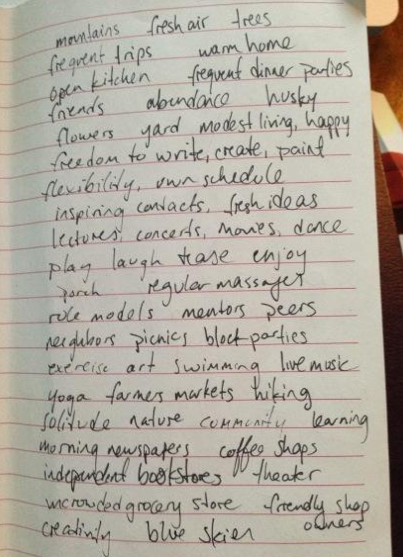
Project: Go find a journal that inspires you. Buy it from that indie book store you’ve always wanted to check out, look for something inspiring while you’re waiting in line, make it yourself.
Writing exercise: Set your alarm for ten minutes. Choose one:

  • Imagine your dream life. Envision everything it entails. Now write. It doesn’t need to be complete sentences or thoughts, words are fine.
  • Ask questions. Write them down, every question you can think of. They don’t need to make sense. You don’t need to have the answers. Tangential is fine. Just ask.

Discuss: What is the difference between dreaming and storytelling? Do you set aside time to create and dream? What stories do you tell yourself? To others?

Week 2

Reading: Tim Ferriss’ 4 Hour Work Week
Project: Do something new this week. Cook dinner with veggies from the local market. Sign up for a class. Explore a new neighborhood. Get lost in a library.
Writing exercise: If you could do anything, anywhere, what would it be?

Discuss: How do you define work/life balance? Is a distinction necessary?

Week 3

Reading: Seth Godin’s Poke the Box workbook
Project: Print out the workbook. Plan thirty minutes of uninterrupted time to complete.
Writing exercise: Notice any areas of hesitation while you’re completing the workbook. Is there a particular topic that seems more challenging than others?

Discuss: What obstacles stop you from shipping? How are you getting in your own way?

Week 4

Reading: Project Exponential’s Host an unforgettable dinner party
Project: Schedule a lunch date or host a dinner party.
Writing exercise: Set your alarm for ten minutes. Choose one:

  • What are the traits you most admire in others?  What are the traits you’re most proud of?
  • Assemble an imaginary Dream Team. You get five players. Who do you choose? What skills do they offer?

Discuss: Talk about how teams are formed and what kind of environments contribute to their growth. What kind of people belong on your Dream Team? Who inspires you?

Week 5

Reading: Jess Pillmores’s Creatively Independent
Project: Challenge yourself to write the first draft of your very own ebook.
Writing exercise: Consider the uniqueness that you, and only you, bring to your work, your relationships, your family. What separates you from competition? What is that one trait that singles you out?

Discuss: How do you stay inspired while working on a big [exhausting] project? What tricks and techniques have you found to be most helpful when setting big goals?

Week 6

ReadingE Myth Revisited and/or Business Model Generation
Project: Brainstorm how you might turn $10 into $100.
Writing exercise: Write out a sample business plan. What would you do if you had no excuses, no responsibilities? Journey back to the days of mowing lawns, selling lemonade, babysitting. What would change if today was your last day at your current job?

Discuss: Would things be different if you consistently set aside time to write, dream, explore, learn?


your dream job is on your desk

What if someone told you that you missed the boat? That the golden ticket to a beautiful home, a happy heart, and an adventurous life was in your back pocket?

What would happen if your phone rang and your boss declared you an asset to the company? If the grocery store clerk looked straight into your eyes and called you a visionary?

What if you found out that “perfect moment” you’ve been waiting for already happened?

What if…

It’s time to find out.

I’ve designed a new offering — part seminar, mentoring circle, book club, networking accelerator, an experience like no other — to challenge you to think beyond “what if” and start venturing into this is it. The first session begins after the holiday season, so you can launch your dreams and your life in a whole new way in 2013.

Learn more about the why and the what here.