bloglovinBloglovin iconCombined ShapeCreated with Sketch. Fill 1Created with Sketch. Fill 1Created with Sketch. Fill 1Created with Sketch. Fill 1Created with Sketch. Fill 1Created with Sketch. rssRSS iconsoundcloudSoundCloud iconFill 1Created with Sketch. Fill 1Created with Sketch. Fill 1Created with Sketch. Fill 1Created with Sketch.

Are you afraid to fail (and talk about it)?

At a recent curated dinner, I asked leaders from a variety of industries to discuss a topic that doesn’t often enter first conversations: failure.

The most successful among us have failed, yet it is a subject riddled with anxiety and fear. We are afraid to be called out as a fraud, so we avoid talking about moments of doubt and insecurity. It is, in fact, the ability to screw up and fail that drives innovation, creativity, clarity, success, and more…

Brené Brown says moments of struggle and failure help us realize who we are.

Seth Godin received hundreds of rejection letters before finding that crack in the system.

Jason Russell and the Invisible Children team hosted countless school assemblies, rallying crowds and spreading their message long before the Kony 2012 video went viral.

Imagine if companies gave “Employee of the Month” awards to those who tried new initiatives and failed. The rule-followers and safe-players? They get pink slips.

Questions to consider:

1. How have failures contributed to the person you are today?
2. How are you encouraging those around you to fail more often?

The anti-resume

I hope one day you realize you don’t need a resume.

The kind of people you want to work with don’t want to see your list of interests and accolades. They don’t care about your work history, what schools you’ve attended, what awards you’ve won.

They want to know what work you’ve put into the world, what you’ve left behind, where you’re going.

The best work stands for itself.

Your resume is the communities that miss you after you’ve left, the imprint you leave behind. The relationships you’ve forged, the lives you’ve touched, and the work that sparkles with your finesse — this is your resume.

When you realize this, you’ll be filled with freedom and independence: titles no longer matter, job descriptions are irrelevant, length of employment fails to indicate your loyalty and value.

Your success doesn’t rest in the hands of another.

Why spend another moment waiting for the phone to ring? You’re worth more than that.

What if you created your own tribe, shipped your own art, designed a viable solution? Don’t wait for opportunities that may never find you. Create them. For yourself.

And change lives along the way.

Lead by example

Whether a small business or large corporation, the head must act in a forthright, admirable way for the chain of command to follow suit. Same applies to smaller groups of people: the leader sets the tone for what is acceptable and what is not, setting the pace for others to follow.

By pushing yourself to be the very best you can be, you inspire those around you, build trust within your team, and encourage others to lead principled lives.

Great leadership shouldn’t be difficult to come by. Neither should integrity.

Good start, better end

Most of our efforts are concentrated on beginnings.

We are taught the importance of starting off on the right track and putting our best foot forward. We want to barrel out of the gate and make great first impressions.
Consider:

  • We rehearse repetitively for auditions and practice months before the big game.
  • First meetings include an extra something — added charisma, a special lunch, a sharp suit.
  • We introduce thoughtfully, crafting emails and inserting interesting tidbits into conversation.
  • We prepare for interviews and spend hours on applications.
  • Our “hellos” are bright, hinting at the potential of what’s to come.
  • We plan in advance and secure reservations for that first date.

In fact, the importance of beginning well has been so deeply engrained into our psyche, that we sometimes don’t even start at all.

But what about endings?

The final performance.
A career change.
The finished paper.
A closed deal.
Finalized contracts.
A meeting’s end.
Goodbyes.
A thoughtful thank you.

What was once a beginning now has a story.

What if we gave endings as much time, energy, and preparation as each beginning? What if we focused on creating an equally successful close?
Instead of simply walking off the court, saying goodbye, hanging up, how can you leave a trace of magic? Is there a ceremony you can create, a finishing touch you can add?
Your work deserves more than a handshake or a subtle nod. Go out with a bang.

man and woman sitting on chair in front of table with food

A free program

If you’ve felt it, you know magic happens when the right people enter a space.

Sometimes it’s serendipity; most of the time there’s a driving force.

I want to encourage you to take part in what Seth Godin has dubbed the Connection Economy — to use your most meaningful relationships to inspire you to create art, contribute to your community, and nourish the connections in your own life.

Deepen the connections in your world and start conversations that matter.

I’m thrilled by the prospect of sharing my passion and work. The capacity for what can happen when the right people come together is unlimited and largely untapped. Call this six-week program whatever you want: a book club, a group, an experiment, an adventure.

There are people in your world who need to meet.

Your efforts to organize this program may change someone’s life, but it’s up to you to make it happen. There are people out there who are stuck (as you may have discovered, paths are rarely straight and laid out). Be present and challenge each other with kindness and care.

We all have something unique to share. Let’s help each other do the tough work.

Questions? Successes? Let me know how it goes.

Step 1. Form a group.

Sure, you can do this alone. But a group offers support, accountability, and the ability to help you up your game. You want people who can call you out, people who can serve as your cohort and personal network as you advance your ideas forward. Your group is your sounding board, letting you know when you’re on track and gently nudging you when you’re off.

It doesn’t matter how many are in your group; it could be one other person or four. Call up a few friends and send out emails, “Will you try something new with me?”

Step 2. Time and place.

Face time can’t be substituted. Choose one location and meet consistently, each week. Settle on the details and commit. Six weeks. No excuses.

Respect everyone’s time. Everyone is busy. Make each other a priority.

Step 3. Finalize your reading list.

I’ve listed several books for you to use as a starting block. Recommended, but by no means required. If you have a book that has been especially influential to you, use that one instead.

Sample book list:
Linchpin
Poke the Box workbook
Superconnect
Business Model Generation
E Myth Revisited
4 Hour Work Week
Creatively Independent
Make Your Idea Matter
Host an unforgettable dinner party

Step 4: Homework (Projects & Exercises):

The activities suggested are designed to get you out of your comfort zone, inspire you, and reinforce what you’re reading. If you feel inclined to add your own twist, please do.

Most importantly, set aside time to make writing a priority. I’ve listed a few prompts to encourage you and provide creative direction. Again, use what is helpful and improve what isn’t. Not everything will work for everyone.

Week 1

Reading: Bernadette Jiwa’s Make Your Idea MatterSample journal
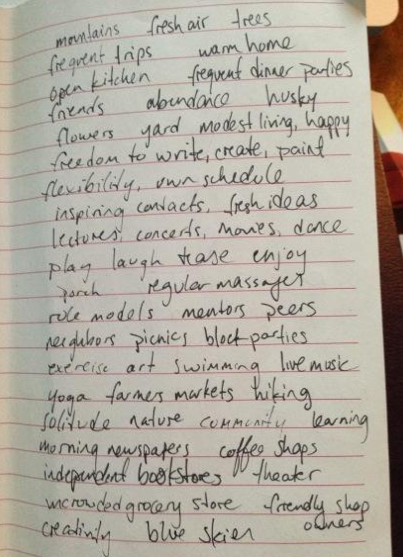
Project: Go find a journal that inspires you. Buy it from that indie book store you’ve always wanted to check out, look for something inspiring while you’re waiting in line, make it yourself.
Writing exercise: Set your alarm for ten minutes. Choose one:

  • Imagine your dream life. Envision everything it entails. Now write. It doesn’t need to be complete sentences or thoughts, words are fine.
  • Ask questions. Write them down, every question you can think of. They don’t need to make sense. You don’t need to have the answers. Tangential is fine. Just ask.

Discuss: What is the difference between dreaming and storytelling? Do you set aside time to create and dream? What stories do you tell yourself? To others?

Week 2

Reading: Tim Ferriss’ 4 Hour Work Week
Project: Do something new this week. Cook dinner with veggies from the local market. Sign up for a class. Explore a new neighborhood. Get lost in a library.
Writing exercise: If you could do anything, anywhere, what would it be?

Discuss: How do you define work/life balance? Is a distinction necessary?

Week 3

Reading: Seth Godin’s Poke the Box workbook
Project: Print out the workbook. Plan thirty minutes of uninterrupted time to complete.
Writing exercise: Notice any areas of hesitation while you’re completing the workbook. Is there a particular topic that seems more challenging than others?

Discuss: What obstacles stop you from shipping? How are you getting in your own way?

Week 4

Reading: Project Exponential’s Host an unforgettable dinner party
Project: Schedule a lunch date or host a dinner party.
Writing exercise: Set your alarm for ten minutes. Choose one:

  • What are the traits you most admire in others?  What are the traits you’re most proud of?
  • Assemble an imaginary Dream Team. You get five players. Who do you choose? What skills do they offer?

Discuss: Talk about how teams are formed and what kind of environments contribute to their growth. What kind of people belong on your Dream Team? Who inspires you?

Week 5

Reading: Jess Pillmores’s Creatively Independent
Project: Challenge yourself to write the first draft of your very own ebook.
Writing exercise: Consider the uniqueness that you, and only you, bring to your work, your relationships, your family. What separates you from competition? What is that one trait that singles you out?

Discuss: How do you stay inspired while working on a big [exhausting] project? What tricks and techniques have you found to be most helpful when setting big goals?

Week 6

ReadingE Myth Revisited and/or Business Model Generation
Project: Brainstorm how you might turn $10 into $100.
Writing exercise: Write out a sample business plan. What would you do if you had no excuses, no responsibilities? Journey back to the days of mowing lawns, selling lemonade, babysitting. What would change if today was your last day at your current job?

Discuss: Would things be different if you consistently set aside time to write, dream, explore, learn?

20 questions to ask as you enter a new year

They work best if you’re honest:

  1. Am I holding onto any beliefs that aren’t serving me?
  2. What do I want to learn this year?
  3. Have I set any long-term goals?
  4. Are my daily decisions setting me up for success?
  5. Do my present priorities accurately reflect my innermost dreams and desires?
  6. Is my work fulfilling my creative desires?
  7. Am I creating time to pursue outside interests?
  8. Do I regularly allow myself to dream?
  9. Is there a specific topic I can learn more about that will help advance my career?
  10. Have I surrounded myself with people who can help me achieve my goals (and encourage me to get there)?
  11. Are my personal relationships fulfilling?
  12. How do I want to be introduced when meeting strangers?
  13. Do I take an active interest in my health?
  14. How can I regularly create a supportive, positive environment for myself?
  15. What lessons have I learned from past failures and mistakes?
  16. What decisions have I made that that support my belief in my own aptitude?
  17. Do I believe that I have art/work/products that will benefit the world?
  18. Am I becoming more of the person I hope to be?
  19. What is preventing me from change?
  20. How can I start today?