bloglovinBloglovin iconCombined ShapeCreated with Sketch. Fill 1Created with Sketch. Fill 1Created with Sketch. Fill 1Created with Sketch. Fill 1Created with Sketch. Fill 1Created with Sketch. rssRSS iconsoundcloudSoundCloud iconFill 1Created with Sketch. Fill 1Created with Sketch. Fill 1Created with Sketch. Fill 1Created with Sketch.

What do you want?

My manual for daily adventure is one of the more popular posts I’ve written on this blog.

People are looking for excitement. They’re looking to add spice and variety to their lives. Sometimes it’s so easy to get stuck in a holding pattern that it feels like it’s too late to get out.

Today, I want to encourage you to carve out time for yourself. Set aside the “shoulds” and “musts” and deadlines and pressing calendar invites. Give yourself the space to ask the following question:

“What do I want?”

I’m serious. Get honest with yourself and listen to the answer. What do you really, really want?

I’m not just talking about a pay raise or a new car. What makes your heart soar? What are the things you dream of? What is your adventure?

What do you want?

If you have trouble with this question, break it down into parts. Think about your career, your love life, your home, your body, spirituality, money.

Is it a title you’re after? Are you wanting to feel connected and respected? Do you look forward to returning home? Is your relationship with your body uplifting and energizing? Do you feel grounded most of the time? Are you creating a life of abundance?

You can take this exercise one step further by writing it down. List what comes to mind when you consider each topic. Post this list someplace you’ll see it often and revisit it regularly to align your daily actions with your long-term goals.

Where you channel your focus is where you’ll attract opportunities.

Find what you love. Find what excites you. Refuse to settle into a rut that’s binding. If you’re in one now, get out. Visualize possibilities and pinpoint goals that will move you closer towards what you want.

Give yourself permission to ask the question (and don’t be afraid of the answer). It might not be clear, it might seem out of reach. The important thing is that you ask.

What do you want?

Daily choices

The choices we make impact much more than our day:

  • conversations we have
  • magazines we read
  • apps we open
  • moments we check Facebook
  • meetings we participate in
  • time we set aside to create
  • phone calls we answer
  • emails we send
  • the moment we power off
  • the times we say no

Set priorities with care. They influence your destiny.

The magic of introductions

If you’ve been the recipient of a polished introduction, you’ve probably failed to recognize its subtle magic. An introduction is a moment of alchemy; part ceremonious, part craft, part prologue. It’s quick, seemingly effortless, and gracefully leads you into an engaging discussion. In the blink of an eye, you’re feeling confident, interesting, interested, and at ease.

A savvy intro builds a bridge between two strangers and shows them a path worth exploring. Most people know how to introduce. Few people know how to turn an introduction into magic.

Improve your next introduction with these 5 easy tips:

1. Do your research.

Know who you are connecting and why. Your familiarity with both parties gives you the upper hand. Use this knowledge to help strangers find common ground.

2. Make it interesting.

Add flavor and insert facts that raise eyebrows. It’s difficult to remember names, but providing a memorable story or colorful detail creates a current for conversation to sail upon.

3. Be smart.

Most people have a gaggle of items running through their mind at any given moment. Your introduction should make it easier for two strangers to engage, not more difficult. Be explicit, direct, and clearly state the intention behind your introduction.

4. Build a platform.

Your introduction sets the tone for conversation to follow. Help those who are meeting each other for the first time enter a comfortable, balanced space. By speaking confidently, clearly, and warmly, you’ll create an environment that’s prime for establishing rapport.

5. Exit gracefully.

Sometimes an introduction is so fantastically successful, you’re doing a disservice by sticking around. Other times, two individuals might struggle to get conversation off the ground. Tune into what’s needed for genuine connection — and know when to leave.

6 ways to turn small talk into real talk

Ask.

Bring thoughtful, open-ended questions to the table. Your prompts can help shape the conversation at hand. If your delivery is honest and curious, you’ll be met with an equally forthright response.

Be patient.

It’s common to feel nervous, get antsy, want to head for the door or look for a new group. The juice comes after the squeeze. Stay where you are. Be present. You don’t need to work the room. A handful of intimate conversations may be more valuable than a dozen superficial pleasantries.

Get vulnerable.

Approach topics that may feel “too close for comfort.” Reveal parts of yourself. Talk passion. Divulging unknown talents and interests will encourage others to do the same.

Tailor your environment.

Your setting can impact your chatter. In a crowded room? Pull a stranger outside or find a quiet corner. Use elements of your setting to feel comfortable and at ease. Find the space that works for you.

Relax.

If you notice you’re fidgety, have a seat and relax. Smile. You don’t need to force anything. Be genuine. Be you. You’ll attract deeper conversations when you’re feeling settled and grounded.

Lead by example.

Set the pace for where the conversation will head. Answer questions with compelling details instead of generic responses. Talk about things that matter. The people who aren’t interested will leave. That’s OK.

man and woman sitting on chair in front of table with food

A free program

If you’ve felt it, you know magic happens when the right people enter a space.

Sometimes it’s serendipity; most of the time there’s a driving force.

I want to encourage you to take part in what Seth Godin has dubbed the Connection Economy — to use your most meaningful relationships to inspire you to create art, contribute to your community, and nourish the connections in your own life.

Deepen the connections in your world and start conversations that matter.

I’m thrilled by the prospect of sharing my passion and work. The capacity for what can happen when the right people come together is unlimited and largely untapped. Call this six-week program whatever you want: a book club, a group, an experiment, an adventure.

There are people in your world who need to meet.

Your efforts to organize this program may change someone’s life, but it’s up to you to make it happen. There are people out there who are stuck (as you may have discovered, paths are rarely straight and laid out). Be present and challenge each other with kindness and care.

We all have something unique to share. Let’s help each other do the tough work.

Questions? Successes? Let me know how it goes.

Step 1. Form a group.

Sure, you can do this alone. But a group offers support, accountability, and the ability to help you up your game. You want people who can call you out, people who can serve as your cohort and personal network as you advance your ideas forward. Your group is your sounding board, letting you know when you’re on track and gently nudging you when you’re off.

It doesn’t matter how many are in your group; it could be one other person or four. Call up a few friends and send out emails, “Will you try something new with me?”

Step 2. Time and place.

Face time can’t be substituted. Choose one location and meet consistently, each week. Settle on the details and commit. Six weeks. No excuses.

Respect everyone’s time. Everyone is busy. Make each other a priority.

Step 3. Finalize your reading list.

I’ve listed several books for you to use as a starting block. Recommended, but by no means required. If you have a book that has been especially influential to you, use that one instead.

Sample book list:
Linchpin
Poke the Box workbook
Superconnect
Business Model Generation
E Myth Revisited
4 Hour Work Week
Creatively Independent
Make Your Idea Matter
Host an unforgettable dinner party

Step 4: Homework (Projects & Exercises):

The activities suggested are designed to get you out of your comfort zone, inspire you, and reinforce what you’re reading. If you feel inclined to add your own twist, please do.

Most importantly, set aside time to make writing a priority. I’ve listed a few prompts to encourage you and provide creative direction. Again, use what is helpful and improve what isn’t. Not everything will work for everyone.

Week 1

Reading: Bernadette Jiwa’s Make Your Idea MatterSample journal
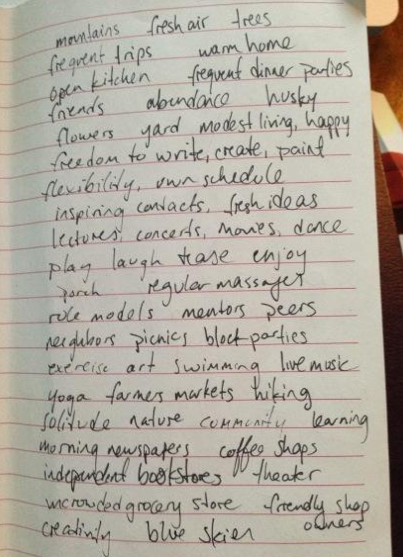
Project: Go find a journal that inspires you. Buy it from that indie book store you’ve always wanted to check out, look for something inspiring while you’re waiting in line, make it yourself.
Writing exercise: Set your alarm for ten minutes. Choose one:

  • Imagine your dream life. Envision everything it entails. Now write. It doesn’t need to be complete sentences or thoughts, words are fine.
  • Ask questions. Write them down, every question you can think of. They don’t need to make sense. You don’t need to have the answers. Tangential is fine. Just ask.

Discuss: What is the difference between dreaming and storytelling? Do you set aside time to create and dream? What stories do you tell yourself? To others?

Week 2

Reading: Tim Ferriss’ 4 Hour Work Week
Project: Do something new this week. Cook dinner with veggies from the local market. Sign up for a class. Explore a new neighborhood. Get lost in a library.
Writing exercise: If you could do anything, anywhere, what would it be?

Discuss: How do you define work/life balance? Is a distinction necessary?

Week 3

Reading: Seth Godin’s Poke the Box workbook
Project: Print out the workbook. Plan thirty minutes of uninterrupted time to complete.
Writing exercise: Notice any areas of hesitation while you’re completing the workbook. Is there a particular topic that seems more challenging than others?

Discuss: What obstacles stop you from shipping? How are you getting in your own way?

Week 4

Reading: Project Exponential’s Host an unforgettable dinner party
Project: Schedule a lunch date or host a dinner party.
Writing exercise: Set your alarm for ten minutes. Choose one:

  • What are the traits you most admire in others?  What are the traits you’re most proud of?
  • Assemble an imaginary Dream Team. You get five players. Who do you choose? What skills do they offer?

Discuss: Talk about how teams are formed and what kind of environments contribute to their growth. What kind of people belong on your Dream Team? Who inspires you?

Week 5

Reading: Jess Pillmores’s Creatively Independent
Project: Challenge yourself to write the first draft of your very own ebook.
Writing exercise: Consider the uniqueness that you, and only you, bring to your work, your relationships, your family. What separates you from competition? What is that one trait that singles you out?

Discuss: How do you stay inspired while working on a big [exhausting] project? What tricks and techniques have you found to be most helpful when setting big goals?

Week 6

ReadingE Myth Revisited and/or Business Model Generation
Project: Brainstorm how you might turn $10 into $100.
Writing exercise: Write out a sample business plan. What would you do if you had no excuses, no responsibilities? Journey back to the days of mowing lawns, selling lemonade, babysitting. What would change if today was your last day at your current job?

Discuss: Would things be different if you consistently set aside time to write, dream, explore, learn?